PanSTARRS 與行星
PanSTARRS and Planets
來源:Luc Perrot|發表日期:2026-04-18
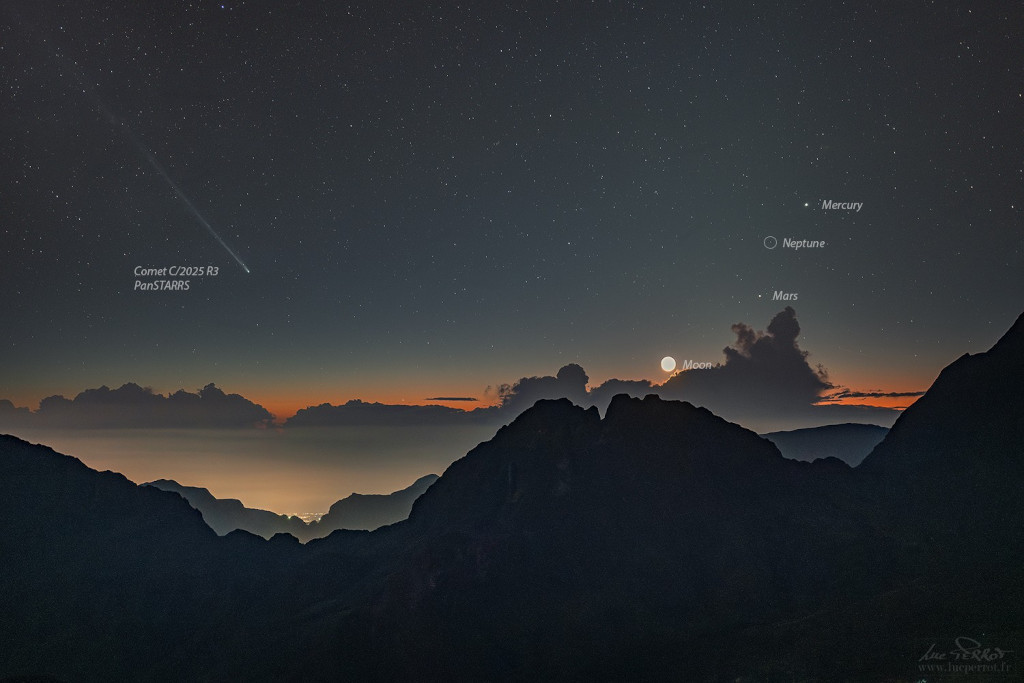
日出前,在東邊地平線附近,C/ 2025 R 3 PanSTARRS 彗星正逐漸變亮。這顆彗星透過雙筒望遠鏡和小口徑望遠鏡已清晰可見,在夜空幽暗的觀測點,它或許即將達到肉眼可見的亮度。儘管肉眼尚未能清晰辨識,但在 4 月 16 日拍攝的這張照片中,PanSTARRS 彗星依然很容易被發現。 這張從俯瞰法國留尼汪島的火山峰拍攝的照片中,這顆彗星與肉眼可見的火星、水星以及較暗的海王星共同點綴在黎明前的東方天空中。土星隱藏在低雲層後方,但這片雲層並未完全遮住一輪老月牙。 對於北半球的彗星觀測者而言,這個週末是嘗試在日出前一小時左右捕捉PanSTARRS 彗星的好時機,因為隨著彗星逐漸接近 4 月 19 日的近日點,其亮度正在增強。 4 月 26 日,彗星將最接近我們的地球,但屆時在太陽的耀眼光芒下將難以觀測。 4 月下旬至 5 月初,南半球將是觀測這顆PanSTARRS 彗星的最佳地點。
原文:Near the eastern horizon before sunrise, Comet C/2025 R3 PanSTARRS is getting brighter. Readily visible in binoculars and small telescopes, the comet may be just on the verge of naked-eye visibility from dark sky sites. Though it was not quite apparent to the eye, PanSTARRS is still easy to spot in this camera image taken on April 16. In the view from a volcanic peak overlooking France's Reunion Island, planet Earth, the comet shares eastern predawn skies with naked-eye planets Mars and Mercury and fainter Neptune. Saturn is hiding behind the low cloudbank that doesn't quite hide an old crescent Moon. This is a good weekend for northern hemisphere comet watchers to try to catch PanSTARRS an hour or so before sunrise, as the comet grows brighter approaching its perihelion on April 19. On April 26 the comet makes its closest approach to our fair planet but by then will be difficult to see in the solar glare. Good views of this comet PanSTARRS in late April and early May will be from the southern hemisphere.
※ 本文由萌芽機器人自動轉貼自每日一天文圖(Astronomy Picture of the Day,APOD),原文為英文,正體中文是透過 DeepL 翻譯及 OpenCC 進行自動處理,內容僅供參考,若有任何錯誤之處還請見諒!
關於每日一天文圖:每日一天文圖網站是美國國家航空暨太空總署與密西根理工大學提供的服務,網站每天提供一張影像或圖片,並由天文學家撰寫扼要說明其特別之處。