彗星R 3 (PanSTARRS)那條細長的尾巴
The Long Wispy Tail of Comet R3 (PanSTARRS)
來源:Haythem Hamdi|發表日期:2026-04-14
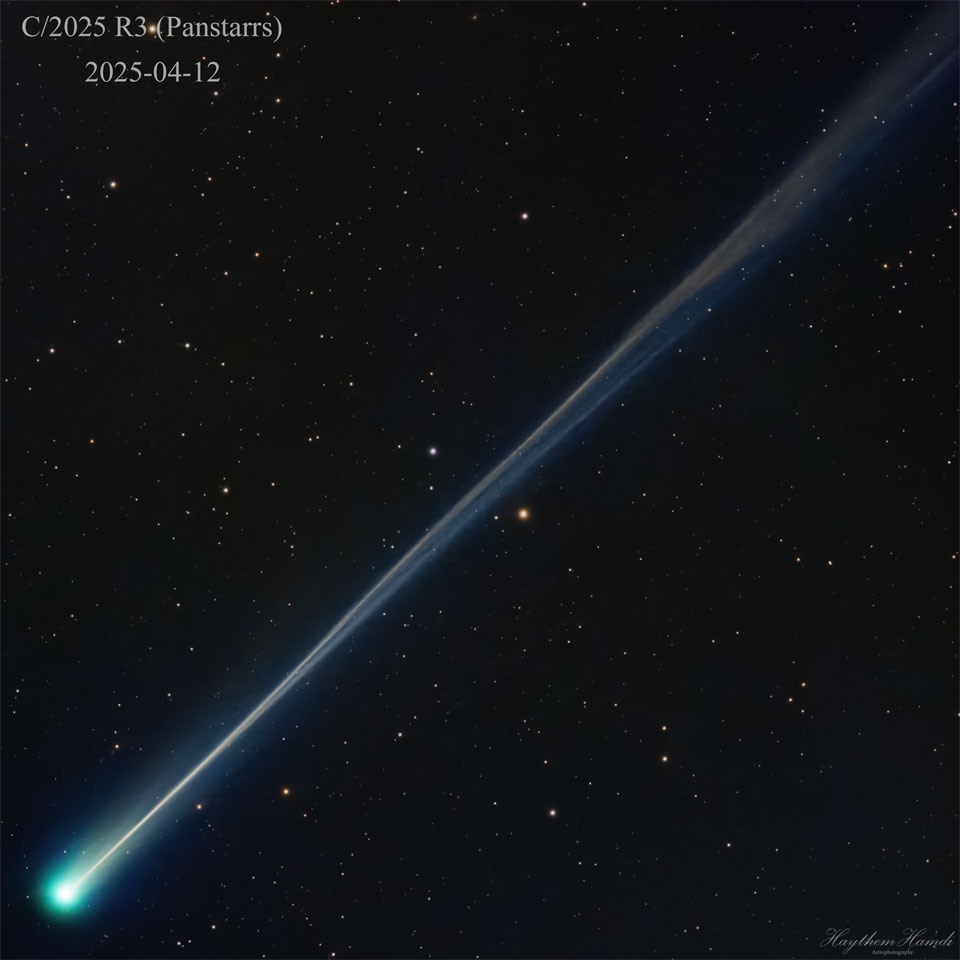
為什麼R 3 彗星(PanSTARRS)會有一個纖細的彗尾?作為太陽系內圈最新出現的明亮天體,C/ 2025 R 3 彗星(PanSTARRS)已經拖出了一道令人印象深刻的光輝氣流。這條彗尾源自一個肉眼不可見的、由髒冰構成的中央彗核,其直徑可能有幾公里。 彗核受太陽加熱後,會向彗發中釋放出一團中性氣體,使其呈現淡綠色光芒。被高能陽光電離的彗核氣體,在太陽風作用下被推離太陽,形成發著淡藍色光芒的離子尾。離子尾呈現出纖細飄渺的形態,正是由於太陽風結構的不斷變化所致。 兩天前在美國羅德島拍攝的彗星R 3 (PanSTARRS)展現出長達數度的離子尾。未來 10 天內,彗星R 3 (PanSTARRS)在黎明前的北方天空觀測效果最佳,此後則在南方天空觀測效果最佳。 不斷擴充的相簿: 2026 年的彗星R 3
原文:Why does Comet R3 (PanSTARRS) have a wispy tail? The newest bright member of the inner Solar System, Comet C/2025 R3 (PanSTARRS) is already extending an impressive stream of glowing gas. This tail starts from an unseen central nucleus of dirty ice that is likely a few kilometers across. The nucleus is warmed by the Sun and emits a cloud of neutral gas into a coma that glows light green. Nuclear gas ionized by energetic sunlight is pushed away from the Sun by the solar wind into an ion tail that glows light blue. The wispy nature of the ion tail is caused by the constantly changing structure of the solar wind. Pictured from Rhode Island, USA two days ago, Comet R3 (PanSTARRS) shows off a many-degree ion tail. Comet R3 (PanSTARRS) is best seen before dawn from northern skies for another 10 days, after which it will be best visible from southern skies. Growing Gallery: Comet R3 in 2026
※ 本文由萌芽機器人自動轉貼自每日一天文圖(Astronomy Picture of the Day,APOD),原文為英文,正體中文是透過 DeepL 翻譯及 OpenCC 進行自動處理,內容僅供參考,若有任何錯誤之處還請見諒!
關於每日一天文圖:每日一天文圖網站是美國國家航空暨太空總署與密西根理工大學提供的服務,網站每天提供一張影像或圖片,並由天文學家撰寫扼要說明其特別之處。