泰德天文臺的春分
Spring Equinox at Teide Observatory
來源:Juan Carlos Casado|發表日期:2026-03-20
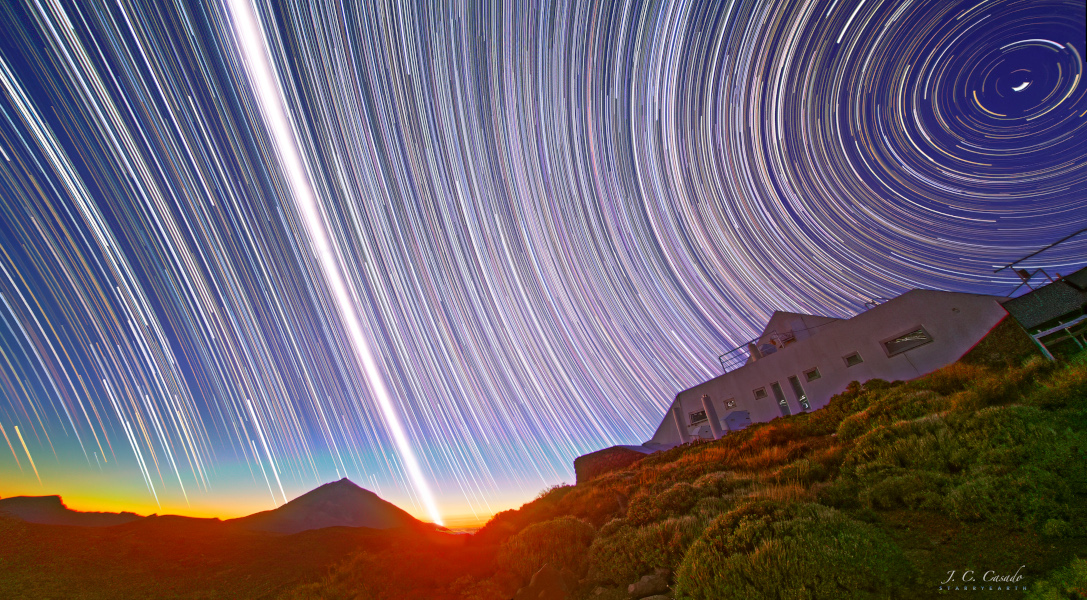
今天春分這一天文時刻的標誌性時刻是協調世界時 14 : 46 ( 3 月 20 日)。此時,太陽在穿越地球天空的年度執行中向北移動,穿越天赤道,標誌著我們美麗的地球上北半球春季的開始,以及南半球秋季的開始。此時,全球各地的晝夜長短几乎相等。 事實上,這張合成星空圖採用了在西班牙加那利群島特內里費島泰德天文臺拍攝的春分日晝夜兩組曝光照片。 在這個宏大的春分專案中,使用魚眼鏡頭拍攝了超過 1000 張照片並進行了合成。春分當日,太陽沿天赤道落下的視運動軌跡,與 6 小時內拍攝的日間曝光序列中那條明亮的線性對角軌跡相吻合。 日落之後,夜間曝光記錄下了星軌,天赤道呈現為一條直線軌跡,而同心圓弧則環繞著位於右上角北極星附近的天北極,以及位於左下邊緣之外(且在泰德峰地平線下方)的天南極。前景中可見遙遠的泰德火山峰頂以及天文臺金字塔形的太陽實驗室大樓。
原文:The defining astronomical moment of the equinox today is at 14:46 UTC (March 20). That's when the Sun crosses the celestial equator moving north in its yearly journey through planet Earth's sky, marking the beginning of spring for our fair planet in the northern hemisphere and fall in the southern hemisphere. Then, day and night are nearly equal around the globe. In fact, both day and nighttime exposures from a spring equinox at the Observatorio del Teide in Tenerife, Canary Islands, Spain, are used in this composited skyscape. Over 1,000 images were taken with a fisheye lens and merged in the ambitious equinox project. The apparent motion of the Sun setting along the celestial equator on the equinox date follows the bright linear, diagonal track from the sequence of daytime exposures taken over 6 hours. After sunset, nighttime exposures recorded startrails, with the celestial equator as a linear track and concentric arcs circling the north celestial pole near Polaris at upper right and the south celestial pole beyond the lower left edge (and below the Teide horizon). The foreground includes the distant Teide volcano peak and the observatory's pyramid-shaped solar laboratory building.
※ 本文由萌芽機器人自動轉貼自每日一天文圖(Astronomy Picture of the Day,APOD),原文為英文,正體中文是透過 DeepL 翻譯及 OpenCC 進行自動處理,內容僅供參考,若有任何錯誤之處還請見諒!
關於每日一天文圖:每日一天文圖網站是美國國家航空暨太空總署與密西根理工大學提供的服務,網站每天提供一張影像或圖片,並由天文學家撰寫扼要說明其特別之處。